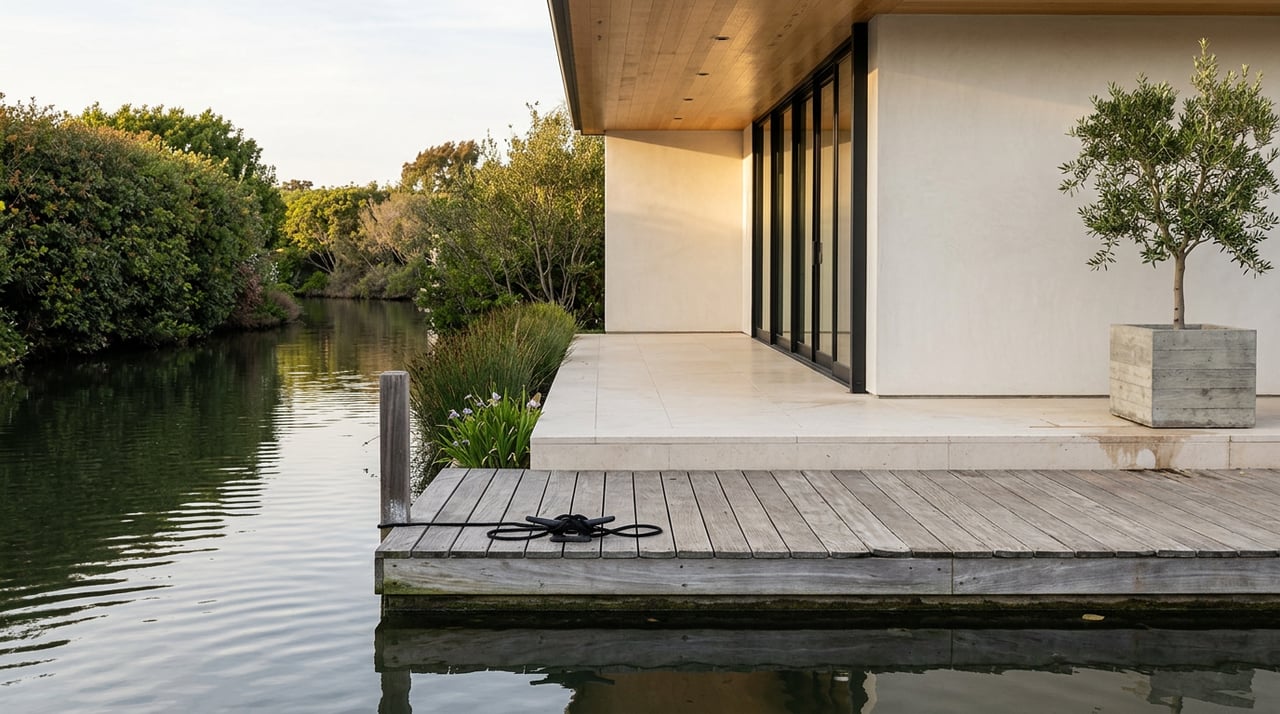
Every buyer touring a waterfront home on the Tiburon Peninsula asks the same question the moment they spot a private dock: is it included, and is it in good shape? That's the right question to ask about the wood and the pilings. The dredging cycle is another consideration when assessing value.
A Paradise Cay dock's usable depth can vary with the dredging cycle.
That cycle is specific to Paradise Cay, and understanding its timing is worthwhile before you write an offer.
Paradise Cay sits at the foot of the Tiburon Peninsula, an unincorporated enclave of just over 200 homes fully surrounded by the town of Tiburon but governed on its own terms. It was built in the early 1960s as one of the last landfill projects the state allowed in San Francisco Bay, turning tidal marsh into finger canals wide enough that many of the resulting docks can hold a 60-foot yacht, according to the community's Wikipedia entry.
None of that history would matter for a buyer's due diligence list if bay mud stayed put. It doesn't. Every canal in Paradise Cay collects sediment continuously, so Marin County created County Service Area No. 29, known locally as CSA 29, specifically so residents could tax themselves to dig the channels back out. The county's own CSA 29 page is direct about the arrangement: the Board of Supervisors set it up to let parcels within Paradise Cay pass special assessments and special taxes for projects like dredging. That tax rides on the annual property tax bill rather than arriving as a homeowners association invoice.
Marin County Public Works describes the maintenance rhythm plainly on its Paradise Cay pages: sediment removal in CSA 29 happens roughly every four to five years. The county's own document archive shows a completed dredge cycle around 2020, with pre- and post-dredge condition surveys on file, and the next round began in the summer of 2024. That 2024 project was budgeted at an estimated $998,000, scheduled to start in mid-August and run about six weeks, with the dredged material barged to the Alcatraz Island Disposal Site under Army Corps of Engineers permit conditions, according to the county's maintenance dredging project page.
Line those two rounds up and the gap is closer to four years than five:
That timing gap is the number worth sitting with, because it means two nearly identical Paradise Cay listings aren't actually equivalent just because they both have docks. A home that closed right after the 2024 dredge and one closing today are sitting at different points on the same depth curve, and only one of those points shows up cleanly in a home inspection. Usable depth at low tide erodes steadily between dredges. A dock that clears comfortably in year one can feel tight by year three, with no visible change to the structure itself.
CSA 29 holds standing ten-year permits from the San Francisco Bay Conservation and Development Commission and the Army Corps of Engineers, covering its community-wide dredging work.
Tiburon maintains a specific tidelands permit application for exactly this kind of shoreline work. If a seller describes a dock as "recently repaired," ask for the permit record as well as details of the work. If no permit record is available, consider whether future work could require additional paperwork.
Belvedere Tiburon sale prices climbed through the first quarter of 2026, with the median reaching $3.3 million across 38 closed sales, up more than 25 percent from the same quarter a year earlier. In a tight inventory market, buyers may consider waiving contingencies or shortening inspection windows. Before making an offer on a waterfront parcel, include a CSA 29 status check and a dock permit request in your due diligence. The dock is a prominent listing feature, and its dredging-cycle position and permit history are details worth checking.
Is CSA 29 the same as a homeowners association? No. It's a county service area created by the Marin County Board of Supervisors, and its special tax is collected with the property tax bill rather than through membership dues.
Does the dredging assessment show up on a standard title search? Not always in a form that flags its purpose clearly. Ask your escrow officer to confirm CSA 29 status specifically rather than assuming it's covered inside the broader county tax line.
A private dock in Paradise Cay is one of the rarer things Marin waterfront living offers, and it earns the extra half hour it takes to check where a property actually sits in the county's cycle before an offer goes in. Elizabeth Green Kilgore has spent nearly two decades working waterfront transactions on the Tiburon Peninsula and can walk you through what a specific dock, and a specific tax bill, actually means for your purchase. Request a Personalized Market Consultation before you write that offer.
This article is general information, not legal, tax or financial advice. Consult a qualified professional about your situation.
Elizabeth is a dedicated advocate for her clients and committed to go that extra mile to help navigate the real estate process seamlessly, whether searching for that “right property” for buyers or mapping out the most effective sales strategy for sellers.
Let's ConnectCompass
1515 Tiburon Blvd., Tiburon, CA 94920 CA DRE# 01441531