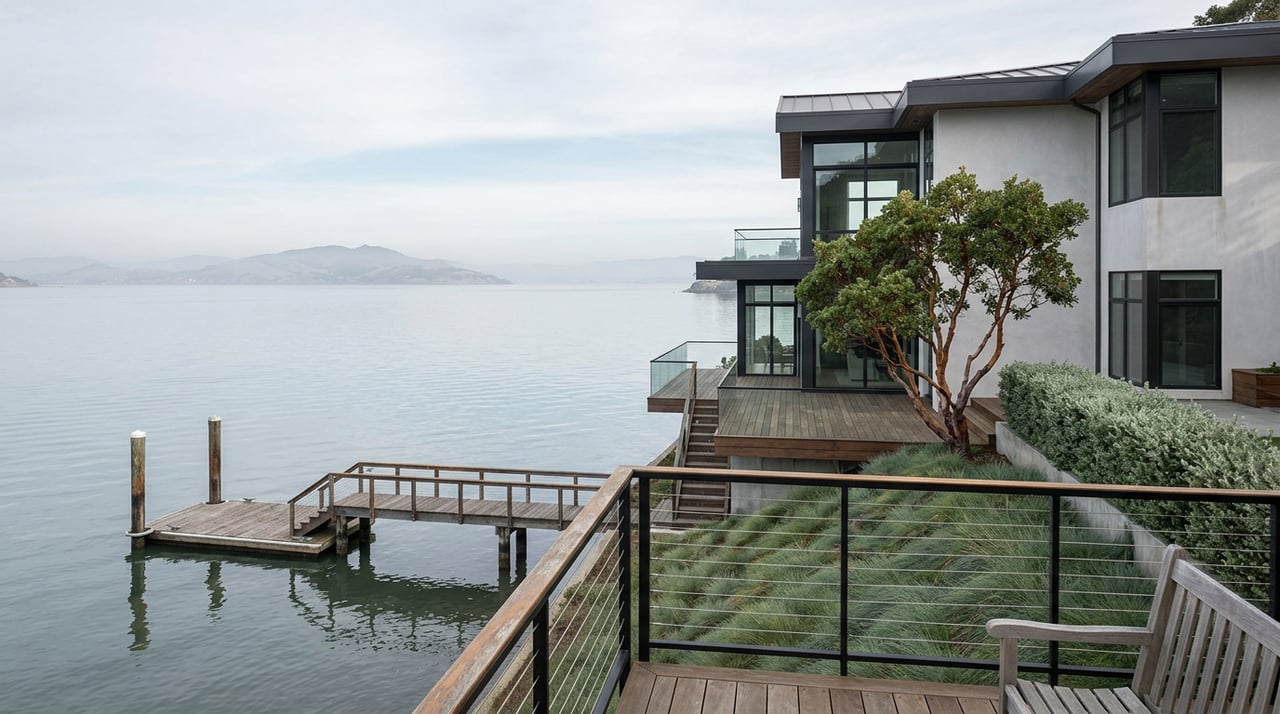
Two floating homes sit forty feet apart on the same dock at Waldo Point Harbor. Same square footage, same view of Mount Tamalpais, same asking price down to the dollar. A buyer touring both would reasonably assume the monthly cost of owning either one comes out about the same too.
It doesn't. And the reason has nothing to do with the homes themselves.
In Sausalito, you buy the structure. You lease the berth. Those are two separate transactions bundled into what looks like a single sale price, and only one of them shows up on the listing. The berth lease sets your monthly fee, your parking rights, and how long you can count on that rate before it moves. Two homes can carry identical price tags and wildly different total costs depending on when the current owner last signed that lease and what happened to the rent when they did.
This isn't a minor footnote. It's the entire economics of the purchase, and as of this year, the rules governing it just changed for the first time since 2022.
Governor Newsom signed Assembly Bill 754 on October 10, 2025, and it took effect January 1, 2026, running through 2038. The bill applies only to floating home marinas in Marin County, and it rewrites how berth rent behaves both year to year and at the moment a home changes hands.
Under the new rule, annual berth rent increases are tied to the change in cost of living, with a floor of 3 percent and a ceiling of 7.5 percent. That's the predictable part. The part that matters more to a buyer is what happens on sale. When a floating home changes owners, and the existing lease qualifies as a long-term arrangement, the marina can reset the rent, but the increase is capped at whichever is lower: 25 percent over the previous rate, or 0.15 percent of the home's sale price. You can read the full text of the bill directly through the California Legislature's own site.
That formula replaced a stricter rule from 2022's AB 252, which had banned any rent increase at all when a floating home sold, a protection known as vacancy control. Marina owners had argued for years that the ban made it impossible to fund aging dock infrastructure and prepare for sea level rise, since a berth's rent could stay frozen at a decades-old rate no matter how many owners the home passed through. The Floating Homes Association's Legislative Action Committee spent more than two years negotiating a compromise with marina operators before AB 754 reached the Assembly floor, where it passed without a single no vote.
The practical result for a 2026 buyer: the rent you inherit is not fixed by law anymore, but it's not open to market pricing either. It's a formula, and the formula depends entirely on the home's sale price and its prior rent, which means the same dock can produce very different outcomes home to home.
A 2024 profile in The San Francisco Standard captured this in a single real transaction. A two-story floating home on South 40 Dock at Waldo Point Harbor sold for $680,000 in February 2020. By 2024 it was listed for $1,050,000. That's real appreciation on the structure. What the listing price doesn't reveal is what happened to that home's berth lease across those four years, or what happens to it now under AB 754 if it changes hands again.
Waldo Point Harbor is the largest floating home marina in the Bay Area, with 282 berths that have stayed fully leased since the 1970s. Every one of those leases has its own start date, its own history of increases, and now its own exposure to the new transfer formula. The same is true across Sausalito's other floating home communities, including Yellow Ferry Harbor, Kappas Marina, and the docks that fall under the Floating Homes Association's coverage. A buyer comparing two listings at similar prices is really comparing two different lease ages, and the only way to know the difference is to ask for the actual lease document before writing an offer, not after.
The second piece of hidden math shows up in financing, and it catches buyers who assume a floating home mortgage works like any other.
Bank of Marin runs one of the only dedicated floating home loan programs serving this market, and its terms are specific: loan amounts up to $1,000,000, available only for one-unit homes with a concrete hull. That's a narrow lane. A home priced above that threshold, or built on a different hull type, or configured as more than one unit, doesn't qualify for that program at all.
| Meets Bank of Marin's criteria | Falls outside it | |
|---|---|---|
| Hull type | Concrete | Wood, steel, or other |
| Unit count | One unit | Multi-unit or converted vessel |
| Loan ceiling | Up to $1,000,000 | Not eligible for this program |
| Financing path | Specialty real-property-style loan | Marine or chattel loan |
Once a home falls outside that lane, the financing conversation shifts to marine and chattel loan products, which are underwritten more like boat loans than home loans. They typically carry higher rates and require larger down payments than a conventional mortgage, reflecting the fact that the lender is securing the loan against a structure rather than land. For a buyer who has already mentally budgeted like they're buying a house, that shift can arrive late in the process and change the numbers meaningfully.
Marin's floating homes are generally assessed as real property for tax purposes, which is a separate question from whether a given home qualifies for real-property-style financing. Those two classifications don't automatically move together, and a buyer needs to confirm both before assuming a purchase will pencil out the way it looks on paper.
It helps to see how different this structure is from another Marin waterfront option a mile or two away. Tiburon's Paradise Cay operates on a completely different model. It's a canal-home subdivision where owners have private backyard docks, and the public marina posts its slip rates openly, month to month, with gated parking as part of the arrangement. That's closer to buying land with boat access than leasing a berth from an operator whose terms depend on a decades-old lease history.
Both are legitimately Marin waterfront living. Neither one is "waterfront" in the same economic sense. A buyer treating the two as interchangeable, or assuming a floating home is simply a cheaper way to get bay access, is comparing two different asset classes that happen to float near the same water.
A few questions are worth asking before a floating home purchase goes into escrow, not after:
None of these show up in a listing photo. All of them show up in the final cost of ownership.
Are floating homes considered real property in Marin? Generally yes for tax purposes, which means standard property tax treatment applies. That classification is separate from financing eligibility, which depends on the specific loan program and the home's hull type and unit count.
Does buying a floating home automatically reset the berth rent to market rate? No. AB 754 caps any increase tied to a sale at the lesser of 25 percent over the previous rate or 0.15 percent of the sale price. There is no open market reset, but there is a formula, and it applies every time the home changes hands.
Is financing a floating home harder than financing a house on land? For many properties, yes. The dedicated bank programs serving this market are narrow in scope, and homes that fall outside their criteria move into marine and chattel loan territory with different rates and down payment requirements.
This is the kind of transaction friction that rarely shows up until a buyer is already deep into a purchase, which is exactly why it's worth working through before you write an offer rather than during it. If you're weighing a Sausalito floating home against other Marin waterfront options, or trying to understand what a specific dock's lease history means for your long-term cost, Elizabeth Green Kilgore can walk through the lease, the financing path, and the comparison to other water access properties across the peninsula before you're locked into a decision.
Elizabeth is a dedicated advocate for her clients and committed to go that extra mile to help navigate the real estate process seamlessly, whether searching for that “right property” for buyers or mapping out the most effective sales strategy for sellers.
Let's ConnectCompass
1515 Tiburon Blvd., Tiburon, CA 94920 CA DRE# 01441531